
On 7–8 March 2026, CEIBA Business School held an intensive Research Design Workshop in Shanghai as part of the DBA programme delivered in cooperation with the Universidad Europea Miguel de Cervantes.
Bringing together doctoral participants working across artificial intelligence, education, marketing and other management fields, the two-day workshop focused on a central challenge in doctoral research: how to transform a broad professional or academic interest into a research project that is focused, rigorous and empirically viable.
Rather than approaching research design as an abstract methodological exercise, participants worked directly on their own projects. Through discussion, feedback and progressive refinement, they developed clearer research questions, identified relevant variables, strengthened conceptual relationships and worked toward research models capable of supporting systematic empirical investigation.
One of the most demanding stages of doctoral research is moving from an interesting topic to a question that can actually sustain a rigorous research project.
Managers and experienced professionals often enter DBA programmes with rich knowledge of organizational problems. Their initial interests may emerge from digital transformation, leadership, consumer behaviour, artificial intelligence, education, innovation or other issues encountered in their professional environments.
The challenge is to convert that experience into a research problem with clear boundaries and a meaningful theoretical contribution.
During the workshop, participants therefore worked on progressively refining their ideas: identifying what precisely they wanted to explain, clarifying the relationships they wished to investigate and examining whether their proposed questions could be addressed through appropriate empirical research.
This process helped participants distinguish between a broad managerial concern and a researchable academic question.
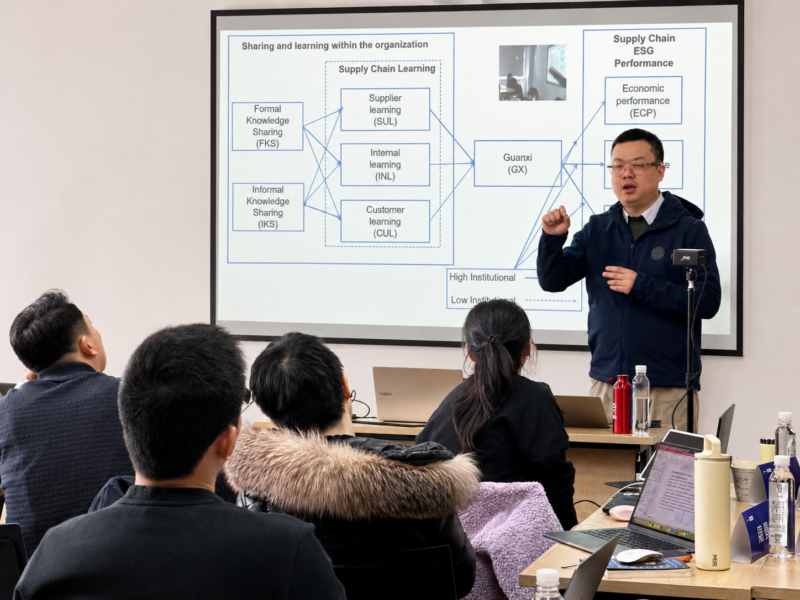
A strong research question is only the beginning. Participants also worked on the conceptual architecture needed to translate their questions into empirical research.
Particular attention was given to identifying and clarifying variables, examining relationships between constructs and ensuring coherence between the research question, conceptual model and intended analysis.
For participants developing quantitative studies, this meant asking a series of fundamental questions: What exactly is being explained? Which variables represent the proposed mechanisms? What relationships should the model test? And how can those relationships be grounded in theory and measured appropriately?
The purpose was not to make research models more complex. On the contrary, participants were encouraged to develop models that were sufficiently focused to be theoretically meaningful, methodologically defensible and feasible within the scope of a doctoral project.
By the end of the workshop, many participants had moved substantially beyond their initial ideas toward clearer research structures and more concrete next steps.
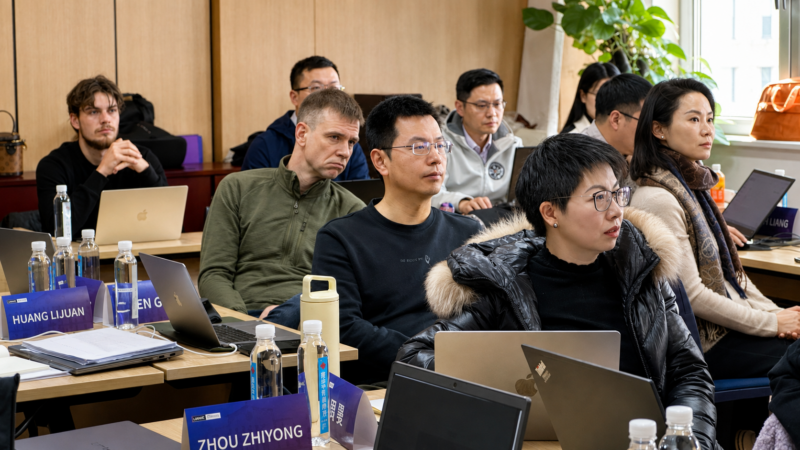
The practical orientation of the workshop reflects a central principle of CEIBA’s approach to doctoral education.
DBA participants bring substantial professional experience to the classroom. Their research frequently begins with problems observed in organizations, industries or wider society. The objective of doctoral training is not to separate that experience from academic research, but to provide the conceptual and methodological tools needed to examine such problems systematically.
Research rigor and practical relevance therefore need not be competing objectives.
A well-designed DBA project can contribute to academic knowledge while remaining closely connected to the realities that motivated the research in the first place. Achieving this requires careful problem formulation, theoretical grounding, methodological coherence and a willingness to continuously refine initial assumptions.
The intensive format of the Shanghai workshop was designed precisely to support that process.
Research projects rarely emerge fully formed. They develop through questioning, revision, discussion and repeated confrontation between an initial idea and the requirements of rigorous inquiry.
Over the two days in Shanghai, participants were encouraged to challenge their assumptions, clarify the purpose of their studies and identify the decisions needed to move their projects forward.
This type of concentrated academic work is particularly important in professional doctoral education. Experienced managers often combine doctoral study with significant organizational responsibilities. Structured workshops can therefore provide valuable opportunities to step away from day-to-day professional pressures and focus intensively on the intellectual development of the research project.
For CEIBA, supporting this transition from professional experience to structured knowledge creation is an essential part of the DBA journey.
The Shanghai Research Design Workshop demonstrated the value of bringing doctoral participants together around concrete research challenges.
The objective was not simply to discuss methodology, but to help each participant leave with a clearer understanding of their project, stronger foundations for the next stage of research and a more concrete path toward doctoral completion.
CEIBA thanks all participants for the seriousness, engagement and intellectual energy they brought to the workshop.
Through demanding, applied and collaborative research training, CEIBA continues to support professionals seeking to transform questions emerging from practice into rigorous research and meaningful knowledge.