

The DBA has taught me not to assume that a new technology creates value simply because it is more advanced. Research requires us to ask who perceives the value, how they perceive it, and what decisions actually change as a result.
DBA RESEARCHER
Hu Weiwei 胡伟伟
DBA Candidate | AI-Enabled Servitization, B2B Relationships and Customer Value
Hu Weiwei is a DBA candidate whose research examines how industrial manufacturers can combine traditional services with AI-enabled services to strengthen relationships with organizational customers.
His doctoral research focuses on a question that is becoming increasingly important for industrial firms: as manufacturers invest in artificial intelligence, predictive analytics, remote monitoring, digital twins and other advanced service technologies, how do customers actually respond to these capabilities, and do AI-enabled services create different forms of value from traditional services?
Rather than assuming that more advanced technology automatically creates more value, his research examines how B2B customers interpret different service portfolios and how these services influence retention, cooperation expansion, referral and willingness to pay a price premium.
Manufacturing firms increasingly compete not only through physical products, but also through services. Traditional services such as technical support, installation, maintenance, training, troubleshooting and consulting now coexist with AI-enabled services involving prediction, intelligent diagnosis, monitoring, optimization, automated inspection and digital twins.
Hu Weiwei’s research asks:
How do organizational customers understand and evaluate traditional and AI-enabled servitization, and how do these service portfolios shape different B2B relationship outcomes?
The study adopts a customer-side perspective and focuses on two important mechanisms.
First, customers may interpret a supplier’s service portfolio as evidence of the supplier’s innovativeness.
Second, customers may evaluate whether the supplier provides credible evidence that its solutions generate real operational or economic value.
These perceptions are then linked to four customer outcomes:
Industrial manufacturers are investing heavily in AI, digital platforms, remote monitoring, predictive maintenance and intelligent services. Yet an important managerial uncertainty remains: Does adding AI to the service portfolio actually change how customers evaluate a supplier?
Hu’s research moves beyond the common assumption that digital transformation is valuable simply because it introduces more advanced technology. Instead, it asks what customers infer when a supplier actually provides a service, proposes it to the customer and demonstrates the capability to deliver it.
The project therefore connects a practical strategic question—how industrial firms should combine traditional and AI-enabled services—with broader issues of innovation, value creation, customer relationships and competitive differentiation.
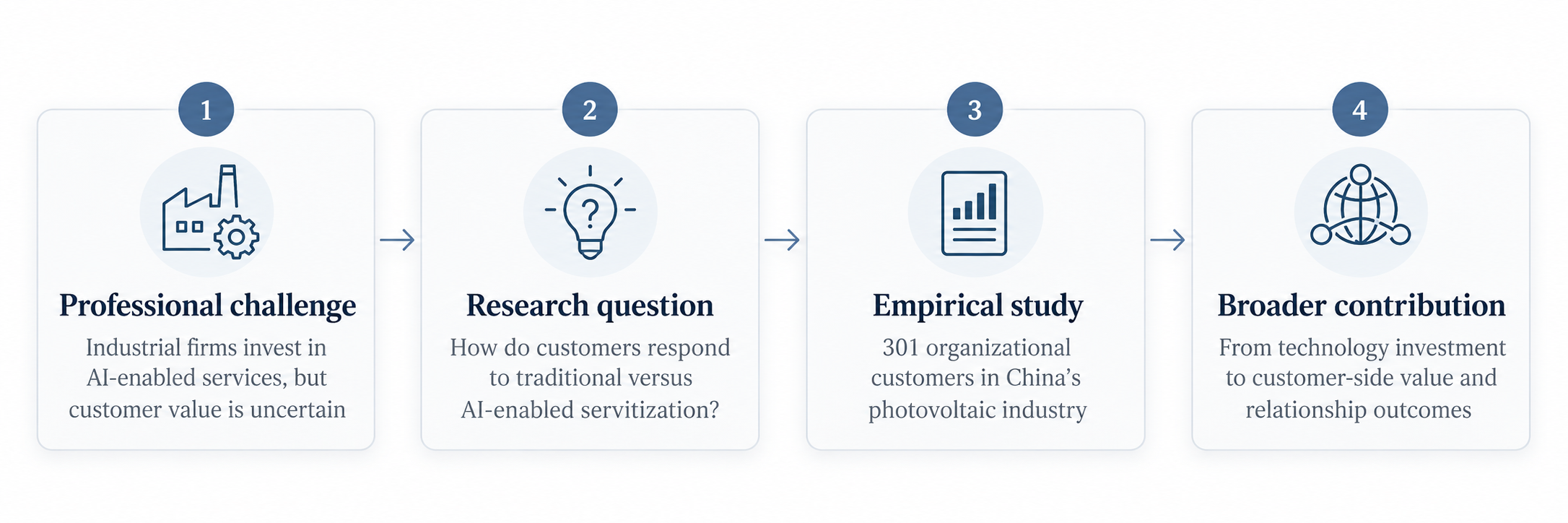
The study is conducted in China’s photovoltaic and new-energy sector, where traditional and AI-enabled services frequently coexist around the same industrial products and supplier relationships. Survey data were collected in May 2026 from 301 organizational customers. Respondents included professionals involved in:
Each respondent evaluated a photovoltaic manufacturer or supplier with which their organization had actual business experience.
Traditional servitization
AI-enabled servitization
The findings suggest that traditional and AI-enabled services can influence customers differently. Traditional servitization is positively associated with customer retention and extension of cooperation. AI-enabled servitization shows positive relationships with retention, cooperation extension, referral and willingness to pay a price premium.
The research also indicates that different customer decisions may be driven by different mechanisms. Perceived supplier innovativeness helps explain why customers may be more willing to recommend a supplier or accept a price premium. Evidence that the supplier creates credible, measurable value is more closely associated with customer retention.
Managerial implication
The key question is not whether AI-enabled services are simply “better” than traditional services, but which combination of services creates which kind of customer response.
Traditional services can remain important for operational continuity and long-term relationship stability, while AI-enabled services can add predictive, diagnostic, optimization and differentiation capabilities.
Servitization · AI-Enabled Servitization · Digital Servitization · B2B Relationships · Industrial Marketing · Customer Value · Supplier Innovativeness · Artificial Intelligence · Photovoltaic and New-Energy Industries
A distinctive feature of Hu Weiwei’s research is that it treats AI-enabled transformation as a managerial and customer problem, rather than simply as a technological one.
The study asks not only what new technologies enable industrial suppliers to do, but whether customers perceive those capabilities as meaningful, credible and valuable.
This connects technological transformation with concrete commercial outcomes including:
This approach reflects CEIBA’s doctoral research model: experienced professionals work with academics to investigate emerging business problems systematically and generate knowledge relevant to both management practice and academic research.
Why I began the DBA
Working in an industry undergoing rapid technological change made me want to understand whether investments in AI actually change how customers perceive and value their suppliers.
The DBA experience
One of the most valuable aspects of the DBA is learning how to turn an emerging business question into a research question that can be tested systematically with customers and data.
From manager to researcher
The DBA has taught me not to assume that a new technology creates value simply because it is more advanced. Research requires us to ask who perceives the value, how they perceive it, and what decisions actually change as a result.