

Research has changed the way I think about digital transformation. I now ask not only what technology a company adopts, but why it adopts it, what capability it develops around it, and whether the resulting innovation is genuinely responsible.
DBA RESEARCHER
Ning Yibing 宁一冰
DBA Candidate | AI Capability, Institutional Pressure and Responsible Innovation
Ning Yibing is a DBA candidate whose research examines how organizations can move beyond the simple adoption of artificial intelligence and develop the capabilities needed to use AI in ways that support responsible innovation.
Her doctoral research is situated in China’s Big Health ecosystem, where firms increasingly face pressure from customers, regulators, competitors and professional communities to adopt AI and digital technologies. Her research asks what enables organizations to transform those pressures into genuine capability and responsible innovation rather than superficial technology adoption.
Artificial intelligence is increasingly presented as a strategic priority, but acquiring AI tools does not automatically create organizational value.
Ning Yibing’s research examines the organizational conditions that allow firms to translate external pressures to use AI into meaningful internal capability and, ultimately, into more responsible forms of innovation. Her research asks a complementary question:
When organizations are under pressure to adopt AI, what enables them to turn that pressure into genuine and responsible innovation rather than superficial technology adoption?
The study distinguishes three major sources of institutional pressure:
It then examines whether these pressures contribute to the development of data- and technology-based AI capabilityand whether stronger AI capability supports responsible innovation through anticipation, reflexivity, inclusion and responsiveness.
Companies increasingly encounter expectations to adopt AI. Customers may demand faster, smarter or more data-driven services. Regulators may require stronger traceability, compliance, documentation or risk control. Competitors may create pressure to follow emerging industry practices.
But responding to these pressures by simply purchasing new technology does not necessarily mean that an organization has developed the capability to use AI effectively—or responsibly.
Ning’s research therefore moves the discussion from: “Should firms adopt AI?”
toward a more demanding question: “What organizational capability must firms develop so that AI can support better and more responsible innovation?”
This distinction is especially important for SMEs, where resources and formal governance systems may be more limited than in large organizations.
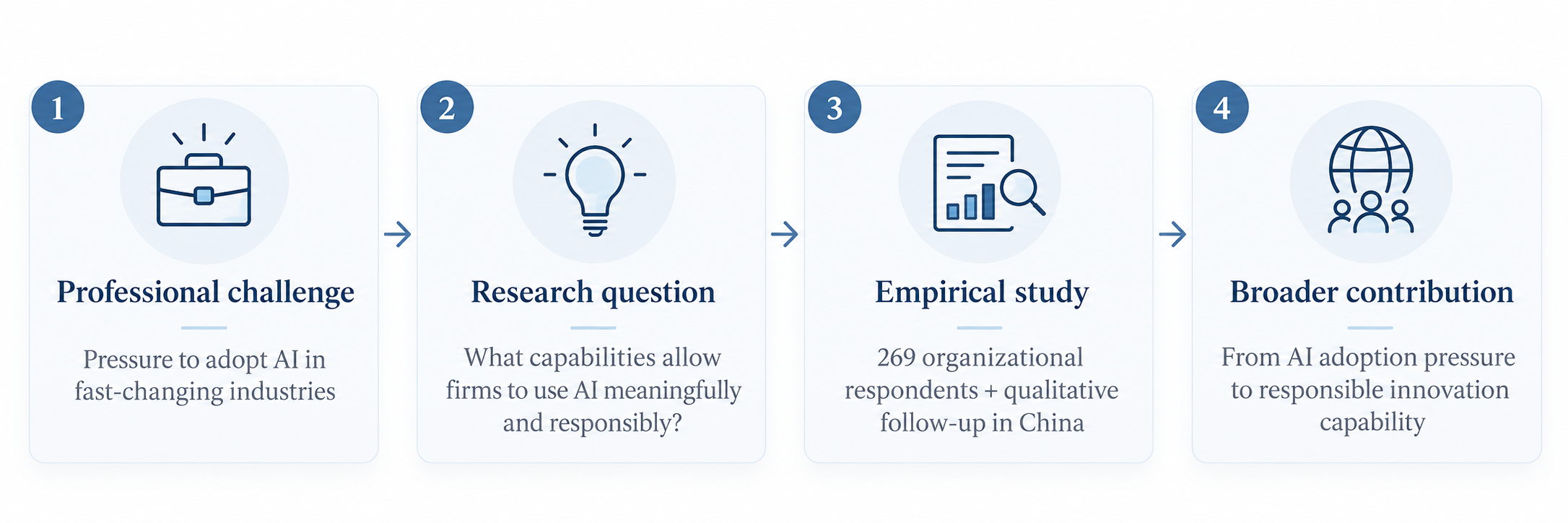
Data were collected in April 2026. Following screening, the final quantitative sample consisted of 269 valid organizational respondents from across China. Respondents included senior and middle managers, supervisors, executives, technical staff and company owners working in areas such as operations, production, supply chain management, technology, R&D and innovation.
The project also includes a qualitative follow-up phase based on semi-structured interviews with managers and professionals. This phase explores how different forms of AI-related institutional pressure influence responsible innovation in organizational practice.
The results suggest that external pressure alone does not tell the whole story.
Coercive market pressure, regulatory pressure and mimetic pressure are all positively associated with the development of data- and technology-based AI capability.
Among these pressures, market pressure has the strongest relationship with AI capability, suggesting that customers, suppliers and other business partners may play a particularly important role in encouraging firms to develop AI-related resources.
The study also finds that institutional pressures are directly associated with responsible innovation.
Most importantly, however, data- and technology-based AI capability is the strongest predictor of responsible innovation in the model. Firms with stronger AI-related data and technological infrastructure are better positioned to anticipate consequences, reflect critically on innovation choices, include relevant stakeholders and respond to emerging expectations.
Managerial implication
Pressure may explain why firms feel they need to act, but capability helps explain whether they are actually able to act responsibly.
Artificial Intelligence Capability · Responsible Innovation · Institutional Theory · AI Adoption · SMEs · Digital Transformation · Innovation Management · Big Health Industry · Organizational Capability · Responsible AI
A distinctive contribution of Ning Yibing’s research is that it avoids treating AI adoption as an end in itself.
Organizations can face strong pressure to appear technologically advanced without necessarily possessing the internal resources required to use AI effectively or responsibly.
Her research therefore distinguishes between external pressure to adopt and internal capability to act.
This distinction has practical importance. Responsible AI transformation depends not only on technology investment, but also on whether firms can develop the data, infrastructure, governance and organizational capacity needed to anticipate consequences, reflect on choices, involve stakeholders and respond to change.
This reflects CEIBA’s approach to doctoral research: starting from an emerging management challenge, developing a rigorous explanatory model, testing it empirically, and then returning to practice to understand the mechanisms behind the results.
Why I began the DBA
I began the DBA because I wanted to understand how AI can help organizations stay ahead in research and product innovation, as well as what really happens inside organizations when they face pressure to adopt new technologies. AI adoption is visible, but the more important question is whether firms can truly develop the capability to use AI meaningfully and responsibly to drive innovation.
The DBA experience
One of the most valuable aspects of the DBA is learning to move beyond asking whether a technology is being adopted and instead examine the organizational mechanisms that determine what that technology actually changes.
From manager to researcher
Research has changed the way I think about digital transformation. I now ask not only what technology a company adopts, but why it adopts it, what capability it develops around it, and whether the resulting innovation is genuinely responsible.