

What I value most in the DBA is that I can start from a real management problem and, with academic guidance, progressively transform it into a rigorous research project.
DBA RESEARCHER
Zha Yingjun 查英俊
DBA Candidate | Continuous Improvement, Lean Management and Employee Empowerment
Zha Yingjun is a DBA candidate at the Universidad Europea Miguel de Cervantes (UEMC) and a Junior Researcher at CEIBA Business School.
His research examines how organizations can build sustainable continuous-improvement capabilities by combining managerial practices with employee empowerment and involvement.
Psychological Empowerment and Employee Involvement as Sequential Mechanisms
Continuous improvement is often associated with tools, procedures and operational methods. Zha Yingjun’s research asks a complementary question:
What makes employees actually participate in continuous improvement?
His study examines how management leadership creates the organizational conditions for improvement through training and employee relations. It then investigates whether these practices strengthen employees’ psychological empowerment—their sense of meaning, competence, autonomy and impact—and whether empowered employees become more actively involved in improvement activities.
The research therefore connects three perspectives: continuous-improvement management, psychological empowerment and employee involvement.
Zha’s doctoral research began with practical challenges encountered in the water-treatment industry.
Water-treatment organizations operate in process-intensive environments where efficiency, reliability, quality and environmental requirements are critical. His initial interest therefore focused on how lean-management approaches—including 5S, total productive maintenance, standardized work, waste elimination and continuous improvement—could help organizations strengthen operational performance.
As the doctoral project developed, the question moved beyond a single organization. It became a broader empirical investigation of the organizational and psychological mechanisms that make continuous improvement possible across manufacturing, environmental, chemical and other process-oriented industries in China.
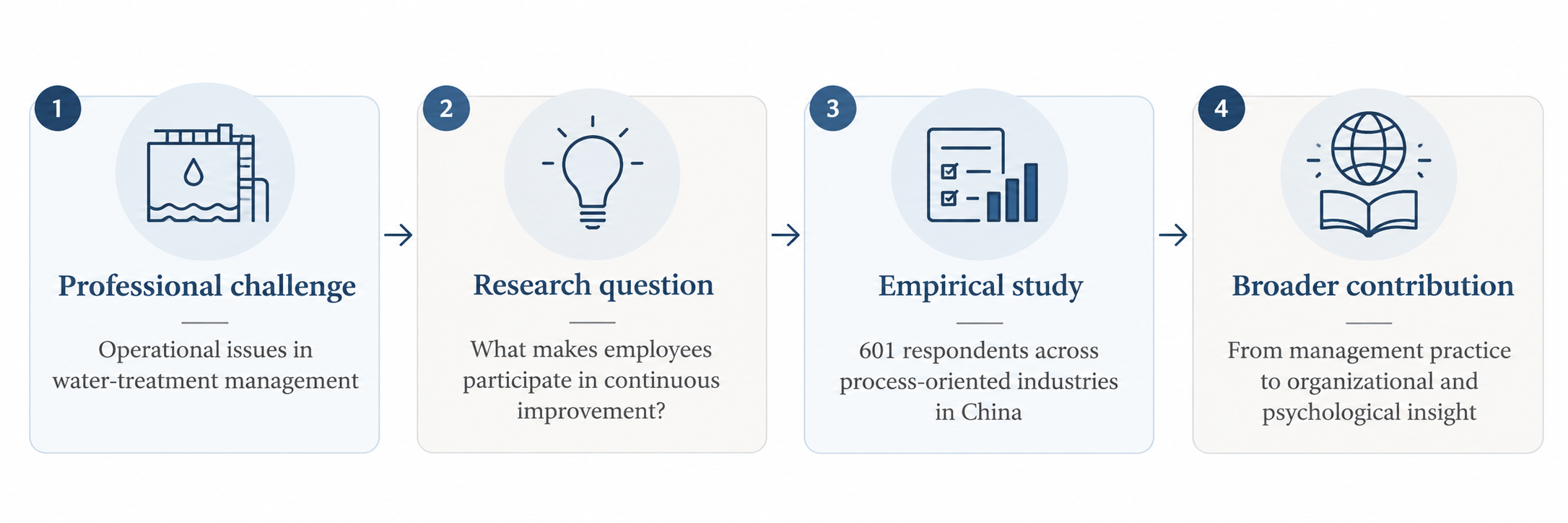
Zha’s study draws on survey data from 601 employees and managers in China who are familiar with continuous improvement, quality management, lean management, operational excellence or related improvement practices. Respondents come primarily from manufacturing, environmental, chemical and other process-oriented industries.
The study examines:
The results indicate that management leadership is strongly associated with training and employee relations. Training and supportive employee relations contribute to psychological empowerment, while empowered employees are more likely to become actively involved in improvement activities.
Employee involvement, in turn, has a strong positive relationship with continuous improvement.
The sequential analysis suggests that leadership can influence continuous improvement through a chain linking organizational practices, psychological empowerment and employee involvement, with the pathway through training appearing particularly important.
Managerial implication
Organizations should not rely exclusively on formal improvement tools. They also need to create conditions in which employees feel capable of contributing, believe that their contribution matters and are genuinely involved in solving operational problems.
Continuous Improvement · Lean Management · Quality Management · Psychological Empowerment · Employee Involvement · Operational Excellence · Water Environmental Services · Organizational Transformation
A distinctive feature of Zha Yingjun’s research is its origin in professional practice. Rather than beginning with an abstract theoretical problem alone, the project started from concrete management challenges in the water-treatment sector and progressively translated those challenges into a research model that can be examined systematically across organizations.
This reflects CEIBA’s approach to doctoral research: enabling experienced professionals to work with academics to transform significant problems from practice into rigorous research and useful knowledge.
Why I began the DBA
My motivation for starting the DBA was to step back from day-to-day management and understand, through research, why some improvement initiatives work while others do not.
The DBA experience
What I value most in the DBA is that I can start from a real management problem and, with academic guidance, progressively transform it into a rigorous research project.
From manager to researcher
The DBA has changed the way I look at managerial problems: instead of moving directly to solutions, I now ask how the problem can be framed, measured, and understood before deciding what should be done.