

DBA RESEARCHER
Dai Yue 戴悦
DBA Candidate | Fatalistic Beliefs, Career Adaptability and Career Development
Dai Yue is a DBA researcher whose work examines how individuals understand the relationship between fate, personal control and individual action, and how these beliefs influence career adaptability, proactive career behaviour and subjective career success.
Her doctoral research grew from long-term professional practice in psychological counselling, life planning and traditional-cultural consulting. Through this work, she repeatedly observed that people facing similar career and life uncertainties often differ substantially in the extent to which they believe personal effort can influence future outcomes.
The DBA changed the way I look at problems. Previously, I focused mainly on finding explanations. Now I also ask whether an explanation can be measured, whether it can be tested, and whether other explanations may be more convincing.
Dai’s research draws on the Career Construction Model of Adaptation (CCMA) to examine how fatalistic beliefs relate to career adaptability and how adaptability may subsequently influence subjective career success through career crafting.
Traditional perspectives often assume that stronger fatalistic beliefs reduce individual agency and adaptability. Her research asks a more nuanced question:
Is the relationship between fatalistic beliefs and career adaptability always simple, linear and negative?
The study distinguishes three dimensions of fatalistic belief:
Her work in psychological and traditional-cultural consulting exposed her to the different explanatory frameworks individuals use to understand personality, career direction, major life choices and psychological difficulties. Her initial DBA idea focused more specifically on the application of traditional Chinese concepts of fate within counselling and career-planning contexts.
As the doctoral project developed, this practical observation was reframed into a more general and empirically testable research question: How do beliefs about whether fate can be changed through personal action influence people’s capacity to respond to career change and uncertainty?
The project therefore evolved from a culturally specific consulting problem into a systematic investigation of fatalistic beliefs, personal agency, career adaptability and career behaviour, using established theories, measurement scales and empirical methods.
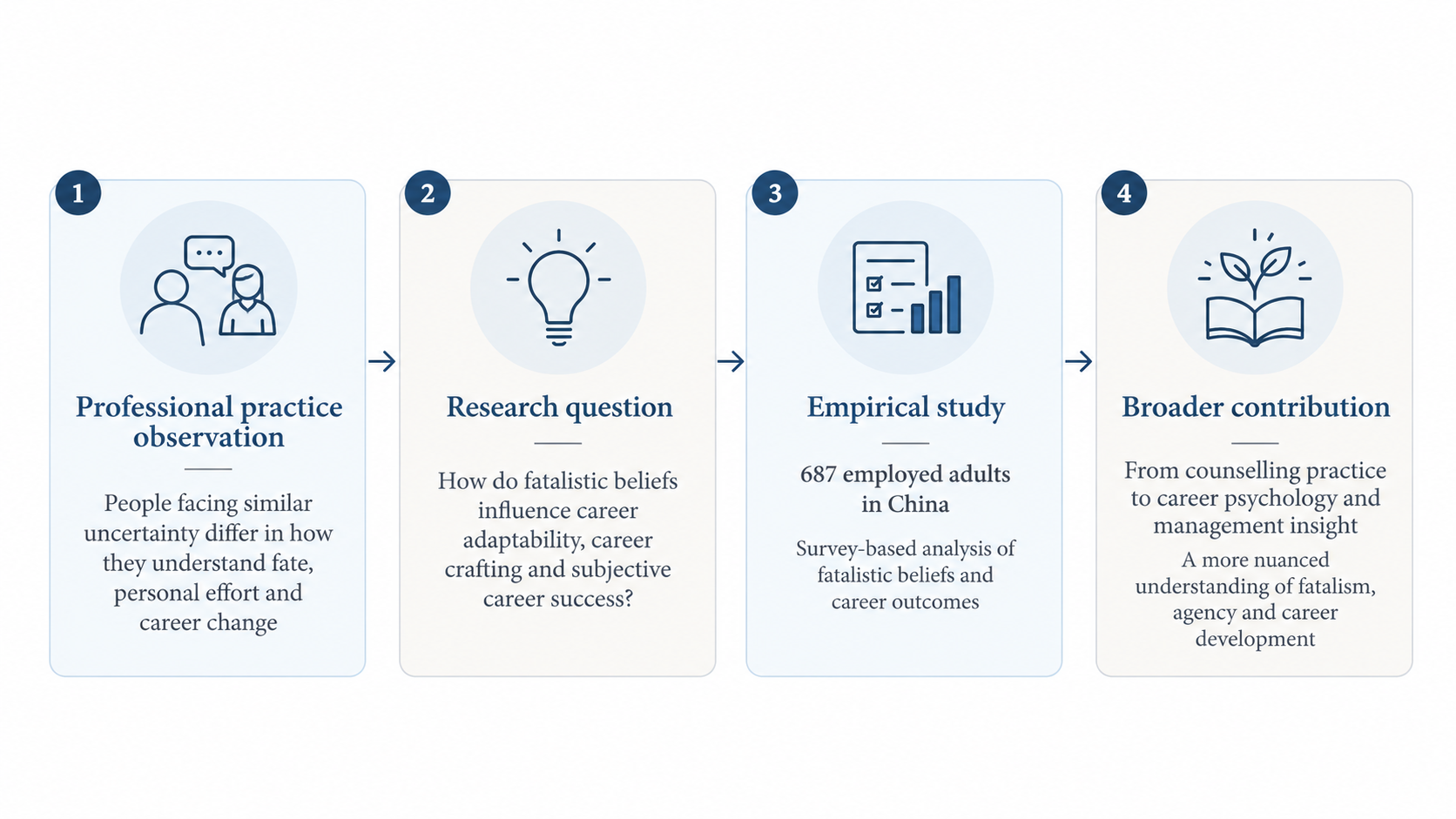
The study surveyed 687 employed adults in China between 19 June and 6 July 2026, covering different industries, organizational types, hierarchical levels and levels of work experience. Respondents came from state-owned enterprises, public institutions, private firms and foreign-invested companies. daiyue(1)
The empirical model examines four groups of constructs:
Fatalistic beliefs
Career adaptability
Career crafting
Subjective career success
The findings challenge the assumption that fatalistic beliefs necessarily undermine career adaptability.
The clearest result concerns helplessness. Helplessness shows significant U-shaped relationships with career concern, career confidence and control–curiosity. At low-to-moderate levels, increasing helplessness is associated with lower adaptability; at higher levels, however, this relationship changes direction. daiyue(1)
Importantly, this should not be interpreted as meaning that helplessness is beneficial. Rather, it suggests that the relationship between perceived lack of control and career adaptation may be more complex than a simple linear decline.
The findings also indicate that different fatalistic beliefs should not be treated as a single psychological orientation. Helplessness shows the clearest nonlinear pattern, evidence for general fatalism is more limited, and luck beliefs do not display the same relationship.
The second central finding is that career adaptability influences career outcomes through actual career behaviour.
Career adaptability is positively associated with career crafting, while career crafting is positively related to subjective career success. The indirect effects linking adaptability to subjective career success through career crafting are significant.
Managerial implication
The study suggests that managers and HR professionals should avoid interpreting employees’ expressions of fatalism as straightforward evidence of low initiative or career potential.
Believing in luck, believing that some outcomes are predetermined and believing that one’s actions cannot change outcomes represent different psychological orientations and may relate differently to career adaptability.
A more productive question for career development may therefore be: Which aspects of the employee’s future do they believe they can influence, which do they perceive as uncontrollable, and what realistic opportunities can the organization provide?
The research also suggests that developing adaptability alone may not be sufficient. Organizations need to create opportunities for employees to translate adaptability into career behaviours such as building relationships, seeking feedback, taking on new responsibilities, developing skills and reconsidering career goals.
Fatalistic Beliefs · Career Adaptability · Career Crafting · Subjective Career Success · Career Psychology · Career Development · Personal Agency and Perceived Control · Chinese Employees and Career Management
Dai’s research originates in a recurring question from professional counselling practice: why do people interpret uncertainty, personal effort and future outcomes so differently?
Doctoral research has enabled her to transform these experiential observations into questions that can be examined through established theories, psychological measurement and statistical analysis.
This transition does not reject professional experience. Instead, it helps distinguish between personal observation, systematically observable patterns and explanations that can withstand empirical examination.
Why I began the DBA
Long-term consulting practice made me realise that people facing the same uncertainty can develop very different understandings of ‘fate’ and ‘personal effort’. I chose to pursue a DBA because I wanted to understand these differences through more systematic and scientific methods rather than relying only on personal experience.
The DBA experience
One of the most important things I have learned through the DBA is how to transform recurring problems from professional practice into research questions that can be examined through theory, measurement and data.
From manager to researcher
The DBA changed the way I look at problems. Previously, I focused mainly on finding explanations. Now I also ask whether an explanation can be measured, whether it can be tested, and whether other explanations may be more convincing.